Wednesday, October 21, 2020

Linkin Park’s Hybrid Theory 20 Years Later - Why We Need Albums Like This


Everyone’s music taste has to start somewhere, and the early 2000s provided a plethora of mainstream bands that filled out a certain niche or genre. Whether it was Green Day’s take on 70s punk or My Chemical Romance’s spin on 80s goth, there seemed to be a gateway band for any style of popular music. However, Linkin Park seemed to culminate several brewing musical ideas from the 90s, and put them forward in a widely-accessible album that would go on to influence an entire generation of alternative musicians.

Hybrid Theory is essentially a crafted blend of nu-metal, grunge, alternative rock and electronic styles. What makes this blend so special is that these styles had all been developing in mainstream and underground scenes throughout the 90s, with Linkin Park taking them all in and putting them forward in a radio friendly album. The notion of which I’m sure would turn some heads to scorn at. However, the difference with Hybrid Theory is that it seems constantly aware of its intended viability, and as such it treats itself accordingly by not throwing any ideas out there to change the game but instead giving a consolidated interpretation of the past decade’s most popular styles, all filtered through ear-grabbing pop production.

The result is a collection of tracks that may not have aged well in concept, but have seemingly resonated with audiences and influenced pop production since their inception. "Papercut" and "One Step Closer" are both nu metal inspired bangers, however instead of delving into the usual nu tropes of blind rage and excessive profanity, these songs take a more emotional lyrical approach. Vocalist Chester Bennington displays a hearty sense of power in his voice, as years of sex and drug abuse are channelled through his screams. Opposing the nu metal sound is the more pop oriented tracks, with In The End and Crawling being huge standouts, the latter of which was the bane of copyright-stricken Youtube videos in 2008. Both tracks work incredibly well as singles, with In The End essentially being a pop song to showcase every aspect of Linkin Park’s sound; the combination of Mike’s rapping with Chester’s chorus vocals that scream of struggle and failure, bolstered by Linkin Park’s inclusion of gritty distorted guitars and turntable scratching. In The End is as much of a surface level example of Linkin Park’s sound as you can get, with elements of the track having seemingly seeped their way into mainstream music following its success. Any top 40 rap song during the 00s had to have a cleanly-sung chorus hook as a result. Meanwhile the vocal stuttering, whilst clearly a product of its time, continues to be used in pop songs to this day. Tracks like In The End might be considered an entry-level song for Linkin Park’s sound and the genres it takes influence from, but in reality that’s the exact point of the song and the band thoroughly knew that. They do experiment slightly with their sound on tracks such as the guitar-driven “A Place For My Head” or the turntablist behemoth “Cure For The Itch” but the band never go too far outside their comfort zone to keep the album commercially viable. Linkin Park knew that people would come to this album without having an inkling of the genres of which they were influenced by, and they played their cards accordingly by giving them what they wanted and in a way, needed to hear.

In reality, what Linkin Park was doing in the US wasn’t too different to what Damon Albarn was doing with Gorillaz in the UK. Gorillaz sounded like a melting pot of the brit pop and hip hop styles of the 90s, the likes of which made the band instantly viable to younger audiences, no less helped by their visual counterpart. Personally, I would never have delved deeper into brit pop or the wider branches of indie music if it wasn’t for Gorillaz, and the same could be said about my love for Linkin Park getting me into heavier and alternative music, as well as hip hop.

Hybrid Theory completely sold me on Linkin Park when I was younger, and they soon became my favourite band as a result. For me, the album acted like a gateway towards the music I would soon get into. Metal, grunge, 90s hip hop and electronic music were all styles that I would soon discover as a result of this album’s infectiousness. So at the age of 21, when I watch videos of Mike Shinoda talk about the influences of Linkin Park, three years after Chester’s death, it comes as no surprise to hear him talk about how the Public Enemy and Anthrax 1991 tour influenced him to start blending rap and rock music. Or how the sound of Hybrid Theory was influenced by the chaos of The Refused’s “Shape of Punk To Come”, or how the stuttering effects on the album’s vocals were influenced by the glitchy electronica of Aphex Twin’s “Richard D. James Album”. These are all artists that I naturally got invested in over my years of interest in music, all of which were unknowingly the result of my love for Hybrid Theory.

I can talk all day about the appreciation I have for this album and what it showed me at such a young age, but what I really want to take away from it is the fact that we shouldn’t immediately ignore a popular album or band just because they are commercially viable. I’d argue that bands like Bring Me The Horizon have been doing a similar thing over the past ten years, with Oli Sykes even citing Linkin Park as an influence multiple times. Sure, they weren’t the first to do what they did and they might not even be the best at doing it, but they can bring that sound to a large audience and keep that audience hooked. Of course these bands and the trends that they follow will all eventually die out, but their impact at the time can bring you onto something you’ve never heard before. We can all cringe at the attempts of popular artists such as Billie Eilish and Yungblud to emulate alternative artists of the past in what seems like soulless, manufactured pop music. However, whilst I and many others do not enjoy their music, I think we should appreciate these artists for making it easier for younger audiences to get into the alternative music that influenced them, just like Linkin Park did with Hybrid Theory twenty years ago.


Thursday, October 8, 2020

MGMT - CONGRATULATIONS Classic Album Review

Seeing as though it turns ten years old this year, I thought I’d put together a quick review of one of my favourite psychedelic albums. Enjoy!!


MGMT debuted with ‘Oracular Spectacular’ in 2008, a mostly commercially viable indie pop record, that spawned a multitude of hits that you’ll no doubt have heard played at literally any indie club night you’ve been to. Despite the level of critical acclaim for the album, it was clear that MGMT weren’t the most fond of being forced into making pop music to achieve success, as evidenced by the ironic lyrics of some of their biggest songs. Two years later, they released their answer to this: Congratulations, an electronic, psychedelic journey where no song could be picked for commercial airplay.

One thing MGMT nailed in their ever-growing quest to denounce their pop origins, is the ability to take you on a ride through multi-faceted songs. Some of the most popular songs on this album, such as Flash Delirium and Siberian Breaks, rely on multi-segmented structures. For the former, it almost sounds as if the band members are becoming more psychotic with each layer introduced. The song takes you through some recognisable psych-pop soundscapes, before holding things back with a choir vocal section, before finally pushing the song even further into interstellar overdrive in it’s frantic ending the likes of which you can only picture the band members' heads exploding as they finish.

Siberian Breaks on the other hand, is the perfect twelve-minute, multi-faceted example of the commercially-viable rejection that appears on Congratulations. Getting through the track feels like a journey. It introduces you with familiar territory - a folky chord progression before alleviating into a gentle, swaying psychedelic melody. Soon enough you’ll be thrust into an adventure with its dreamy highs and slower, melancholic lows. At times the music progresses through some sections with colder acoustic guitars and other sections with warmer synths that warp through the instrumentation. The song makes me feel like I’m sludging through the Siberian Alps on acid. Before you finally leave this adventure, the band gives you an outro that consists entirely of synthesisers, which only helps to emphasise and place importance upon the wide range of instrumentation and sounds that this song uses to take you on it’s adventure.

One aspect that greatly benefits the sound of Congratulations was the introduction of Spacemen 3 synthesiser maestro Pete “Sonic Boom” Kember in the production role. Almost 20 years after the success of his work with shoegaze pioneers Spacemen 3, and Kember has proved that he never really did kick the shroom addiction. Congratulations is complete with Kember’s use of tremolo, delay and layered synths that really give the album it’s warbling and colourful synthesiser setup. The glittering synths and dreamy soundscape of the title track is a definite standout for his work. 

It’s elements like the introduction of Kember that really make Congratulations what it is. MGMT wanted to shrug off their electronic pop roots and make an album that embraced their influences, so it’s no surprise that the Spacemen 3 member was placed in the production role. Adding to this are songs such as Brian Eno, and Song For Dan Treacy, both of which pay tribute to the musical icons in their title, who are evidently massive influences for the band’s mix of post-punk, psychedelia and electronic music.

As an album, Congratulations doesn’t really do anything wrong. It takes the sound of the band’s debut and pushes it in a direction that seeks to explore it. However, that exploration didn’t lead to MGMT seeking another set of smash indie-pop hits. Instead it takes risks with its attempts to take you on a psychedelic journey through MGMT’s influences, madness and attention to detail.


Thursday, September 24, 2020

WAGTAIL - NINE SONGS ALBUM REVIEW


First thing that hit me about this new Wagtail album?: how uncompromisingly fucking weird it is. Realistically it has the intensity of a man trapped in a burlap sack being savagely kicked to death by Warwick Davis dressed as a Stasi Officer. Everything this album holds comes together as what I can only describe as lo-fi Americana. Each piece of it’s nine-song runtime, complete with trumpets, trombones and mellotrons, give the album the vibe of a bastardized film soundtrack lost in time.

Mostly, Wagtail’s debut is a collage of weird and wacky ideas that paint a lonesome and frenetic picture. Anything goes with this album’s attempts to thrust you into it’s warped and tuneful soundscapes. Nothing is held back on the opening song in particular, as “Slowly The Grease Drips” plays out like a spaghetti western soundtrack from hell, complete with layers of sound that forcibly drown a distressed spoken word section in the second half. This is complemented nicely with the swaying, moody grooves of the following track: “There’s No End”. Offering a more conventional structure, the track paces the album nicely after the insanity of the opening song, however it’s gothic grooves add a darker tint to the album’s story. Numbers like these are an instantaneous example of the band’s care-free, no boundaries approach to songwriting.

These differentiating styles and influences make for an incredibly exciting listen. One moment you’ll be caught with the sludging loneliness of “Where's The Money At?” before being thrust into the frantic psychedelia of “The Sleep (I Need My)”. The album’s merit lies in its uncompromising playfulness, leading the listener to not know what to expect next.

The only problem that listeners might encounter is the album’s production and mixing. At times the amount of layers of effects, instrumentation and noise can become overbearing in the mix. From the album’s perspective however, this is a complete blessing. Relating back to the aforementioned opening track, it’s spoken-word segment sounds almost as if it is being succumbed by the ensuing walls of sound that build up. As they continue to build, the vocals become more strained and desperate until the instrumentation closes in and ensues it. It’s almost as if the song’s protagonist is being slowly but surely strangled into silence.

There aren't many local releases that sound anything quite like Wagtail’s debut. It's a weird mix of lo-fi ideas that culminate in a multi-layered trip through Americana, psychedelia and folk, through which it tells a frighteningly manic yet joyful story draped in layers of reverb and noise. Definitely worth a listen if you’re looking for something care-free and creative during these trying times. 

You can purchase the album digitally or neb yourself one of the few remaining cassette versions here:

Saturday, September 19, 2020

THE HUNNA / JAWS LIVE AT UNITY ARENA 14/09/20 Gig Review

Image courtesy of Will Gorman

If ever you wanted a trip back to 2016, a one which showed you everything you loved and loathed from that year, then this gig was it.

For a band that essentially played reworked versions of New Order’s Ceremony for their entire set, Jaws ended up being the most impressive act for the night. Whilst their indie pop jams are definitely beginning to show their age, their musicianship and presentation demands more praise than you would expect. Coupled with their porefessional performance ability, their repetitive lyrics and reverb-drenched jazzmaster tones will give them a dead horse to beat for years to come.

On the other hand was The Hunna, a band which accumulated a massive following during 2016/2017. This was somewhat attributed to their constant touring during those years, which itself has definitely paid off as the band’s drive to put on a good show was paramount during their set. They were definitely good at holding the audience to attention and keeping up an energetic vibe, despite the fact that their vocalist was the only member with any sort of stage presence. The problem is that this all falls flat when you actually hear The Hunna’s music. All of their songs (albeit one acoustic ballad) attempted the clean, powerful grooves of mid 2010s popular rock bands such as Royal Blood and Bring Me The Horizon, a sound itself that has already dated horribly over the last five years. These songs, with their repetitive lyrics and derivative musicianship, all seemed to mesh together into one big mess of soaring choruses and simplistic heavy grooves.

If anything should be taken away from a gig like this, it’s the outrageous nostalgia hit that I’m sure most older fans of these bands would get. If you had a good time with them during their early tours four years ago, then I’m sure you’d enjoy them now as their live shows seemed to have improved more than their songs. Even if you’re not a fan of either bands and never will be, it was still a nice opportunity to see a group of musicians get back to doing what they love for the first time in five months.


Wednesday, July 15, 2020

DAY 2 - THE UNHOLY COMMUNION OF NOISE MUSIC AND FUTURISM ART - FEATURING CHARLIE SANDERS


Mine and Charlie’s previous attempt to get one of these posts out every day ended up falling completely flat. Charlie has been working on multiple projects over the past few months and a daily project became too much for both our schedules.

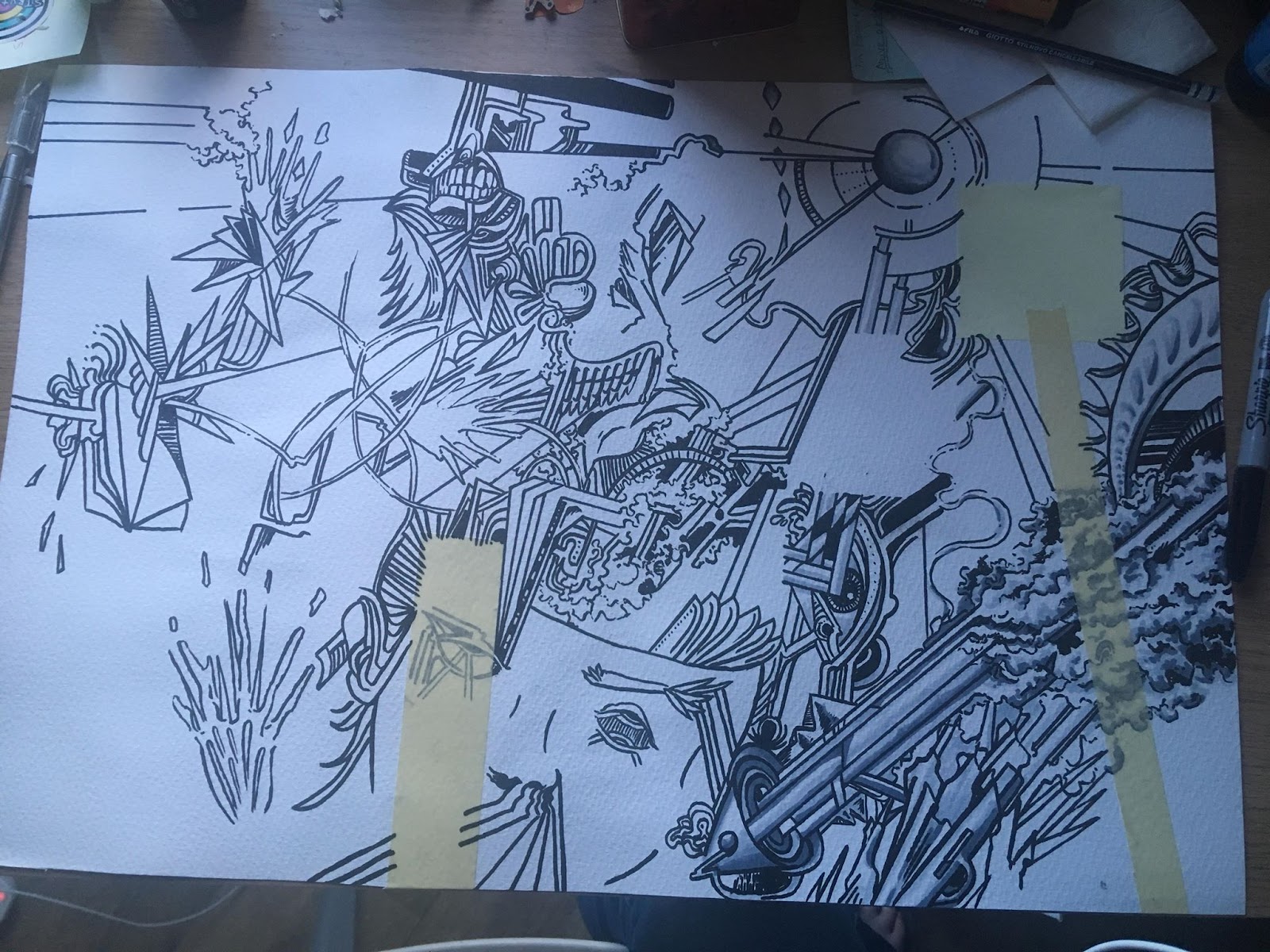
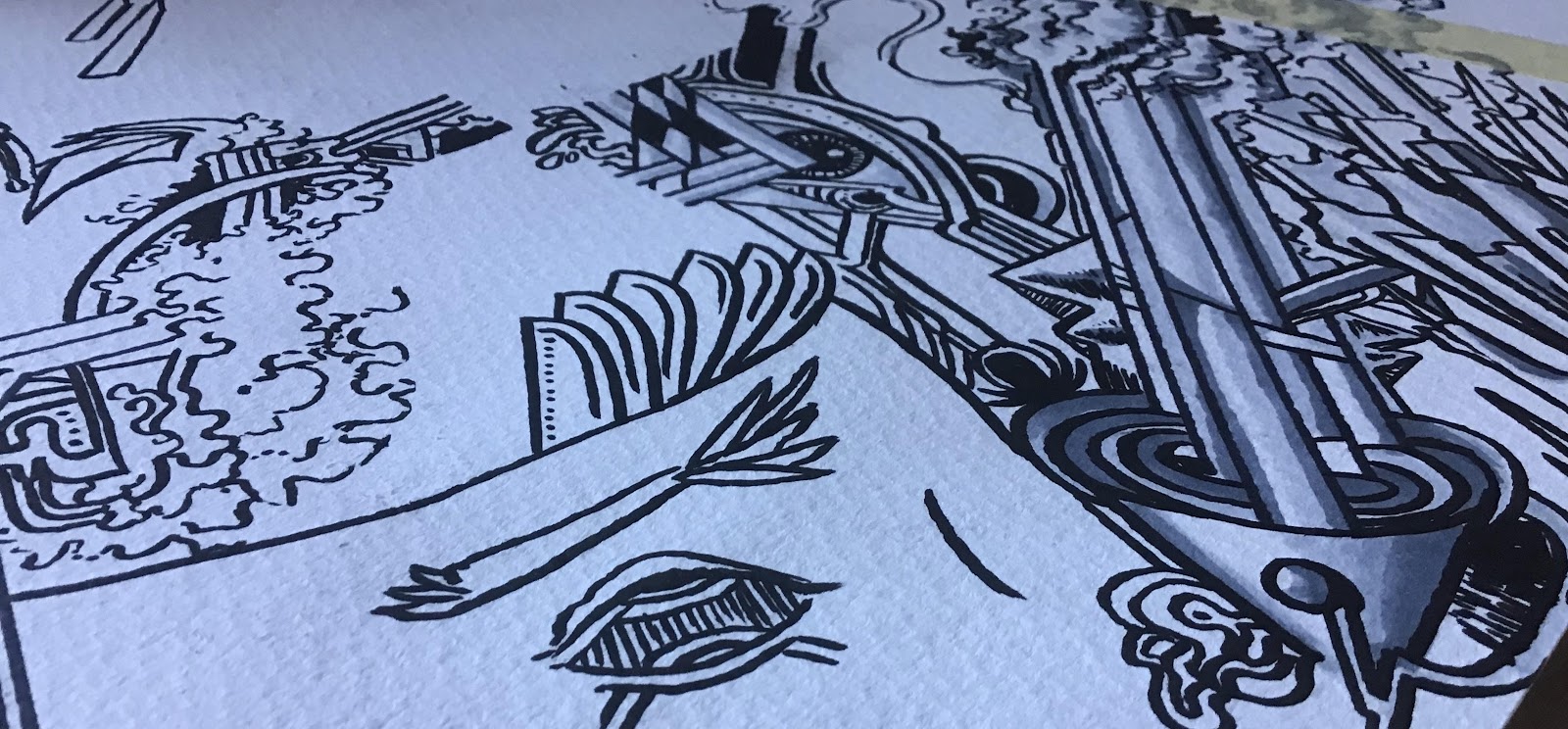
As a result, he’s completely restarted the futurism piece into something that is already looking incredible. You can view the first steps he has taken in this new piece, as well as the music that influenced it below.

Also included is a short interview with Charlie.


What did you listen to and how did this affect the futurism piece?
I listened to the complete works of Edgard Varèse, Pulse Demon by Merzbow and Colour Quanta by Kim Cascone.

Merzbow - Pulse Demon (1996)
https://www.youtube.com/watch?v=ukZYP5Dy43E


What influenced you to start the piece again?
I felt like I was being too restrictive with what materials I’d chosen for the window of time we decided to do it in, and I’d struggle to make something that properly expressed the experience accurately in that way.


What made you decide to work on a futurism-inspired piece?
Mainly due to futurism and noise music historically going hand in hand, as well as the visually chaotic look but with an underlying theme that felt like it really fit.

Toshimaru Nakamura & Kim Cascone - Blue Powder (2017)
https://www.youtube.com/watch?v=SL6rSPkU9H0


What made you decide to use noise music as an influence?
Mainly because I haven’t really sat to listen to it properly in the past, and this seemed like a good opportunity to have something come from it as well.

Edgard Varese - Complete Works Volume 1 (1951)
https://www.youtube.com/watch?v=LEtuTzdCr6s


How has music influenced your art in the past? Is it a key component during work?
Music is a huge part of my work in general, I always listen to music while doing work, it’s basically part of my entire process and it very much influences what I actually create in the end and the style and themes of the music come through.


I will continue to post Charlie’s work as he progresses on it, I won’t be sticking to a posting routine and rather will post sporadically until Charlie finishes the piece.

Monday, June 29, 2020

DAY 1 - THE UNHOLY COMMUNION OF NOISE MUSIC AND FUTURISM ART - FEATURING CHARLIE SANDERS


The first day into our week-long project with Charlie Sanders centeres around the music of  late 60s composer Edgard Varese. His work is credited as a major influence to electronic and noise music. Using it as a basis to influence the beginning of his futurism inspired work, Charlie had this to say:

"In regards to the music, it was interesting to listen to some more classical noise music since it wasn’t heavily electronic like how we think of most noise music now. I enjoyed the vocal segments on songs, specifically ‘Nocturnal’ I thought had a lot of depth, and the lyrics really added to the atmosphere of it. I found it much more universally ‘listenable’ than majority of modern noise music at least".


"Futurism from an artistic point of view is really interesting, the concept of trying to capture movement and power before the moving picture was widely accessible is a very interesting premise, but it’s understandable when viewed in the context of the time. With the second industrial revolution peaking, the combustion engine starting to overtake steam power, manufacturing of steel dominating the world, it was understandably an exciting time to be looking to the future". 

"You can see futurism reflected in the music I listened to today as well, lots of ramping up sounds like a car speeding up, or air raid siren like noises flowing around the rest of the instrumentals. It also constantly carried a feeling of urgency and unpredictability, which actually had my heart racing as some points honestly when I was wrapped totally in the music. Overall I enjoyed it a lot.

Listen to Edgard Varese's "Nocturnal", the track which has influenced the early stages of Charlie's piece, through the link below:
https://www.youtube.com/watch?v=SN_5oUL_9xE&feature=youtu.be&fbclid=IwAR1nEYSQWmm5aOh-28oKKYJZp4THWVZu9u51lI8JrCv7nsMZmFV9XR805b8

We'll be back tomorrow night with another update on Charlie's exciting work.

Friday, June 5, 2020

7 Important Songs For Racial Discussion - Featuring Phibi Olumide


In a time as heated as this, it’s important to educate ourselves on the reasons why we’re fighting against racism. Seeing as though music has always been an important tool in pushing challenging ideas and questioning the norm, I got in contact with musician Phibi Olumide to help me collate 7 songs which we urge you to listen to. Each one tackles racial disputes, struggles and prejudices in their own way, making them extremely relevant to our current situation.

I also suggest you check out Phibi’s music on Soundcloud.

https://soundcloud.com/user-985268993/cycles/s-hMzjQPsI9RM


PHIBI’S PICK:

Billie Holiday - Strange Fruit (1957)
https://www.youtube.com/watch?v=Web007rzSOI


“First song that hit me hard in my youth was Billie Holiday’s "Strange Fruit", it's still a hard song to listen to now really. I think that song is important because of how raw it is. How blatant it is. It doesn't let you hide behind the fact "slavery is over" because black people were still hung from trees long after slavery was abolished”.


RYAN’S PICK:

Rage Against the Machine - Voice Of The Voiceless (1999)
https://www.youtube.com/watch?v=V4A0Qya23y0


It took great difficulty to pick a Rage Against The Machine song to fit this list as they have a full discography of material that comments on racial prejudice. However, “Voice Of The Voiceless” stands out as it commented on the unfair trial of Mumia Abu-Jamal, a Black Panther spokesperson convicted and sentenced to death over the murder of police officer Daniel Faulkner. This was a very serious and real case at the time, with many including the members of RATM arguing that Jamal was innocent, with clear evidence that the case against him was racially charged.


PHIBI’S PICK

Jay Z - The Story Of O.J. (2017)
https://www.youtube.com/watch?v=RM7lw0Ovzq0


“I remember when I first heard this song, I showed my whole family. Jay Z sheds light on the mindsets of American people both black and white. No matter how rich you are or how important, you're still a n****r. He also says how frustrated he is when African Americans would prefer to get rich, rap about it and die young rather than invest that money into themselves and their community. I think it shows the destruction of the mind America likes to keep pushing”.


RYAN’S PICK:

Bob Dylan - The Lonesome Death of Hattie Carroll (1964)
https://www.youtube.com/watch?v=FmbwU3J-2kk


Dylan’s 1964 album “The Times They Are a-Changin” presents the early 60s as an intensely divided time. “The Lonesome Death of Hattie Carroll” is one such track from the album that discusses racial prejudices in America at the time. The track explores the death of an African-American maid at the hands of a wealthy white man, who was only sentenced to six months in prison. Dylan doesn’t hold back in delivering every unfair and brutal aspect that plays into a situation involving prejudice in this way, it's one of his darkest songs as a result.


PHIBI’S PICK:

Earl sweatshirt - Chum (2013)
https://www.youtube.com/watch?v=FCbWLSZrZfw


“This may be a personal one since I'm multicultural and my dad looks white but there's a line in the song that I resonated with deeply "too black for the white kids and too white for the black kids". Earl is African American but he's into skating and punk etc. There's also pressure to be a proper "black person" and obviously there's always going to be issues staying with the white kids. Most people kind of feel stuck in the middle. Culture is important, race however should not determine someone's predisposition. Fucks with the mind when you're expected to be a certain way because of the colour of your skin”.


RYAN’S PICK:

Public Enemy - Burn Hollywood Burn (1990)
https://www.youtube.com/watch?v=Vt1KfJhyMqw


Never had a hip-hop group ever been as unapologetic as Public Enemy. In their prime, they aimed to push challenging lyrics and ideas through energetic and loud production. “Burn Hollywood Burn” features none other than Ice Cube and Big Daddy Kane, and it completely critiques black stereotypes in Hollywood. From referencing the use of black face to commenting on black representations as gang members on TV, Public Enemy hold nothing back in their callouts of racism and stereotyping in American film and media.


PHIBI’S PICK:

Dave - Black (2019)
https://www.youtube.com/watch?v=pDUPSNdmFew


“One of the most uplifting and beautiful songs to hear as a black person truly. He talks about the struggles but he sheds light on the beauty of being black. I cried listening to that actually haha”.